
Clindamycin 300 mg is an oral antibacterial capsule containing 300 mg of clindamycin. It belongs to the lincosamide class of antibiotics and works against susceptible bacteria by interfering with bacterial protein production.
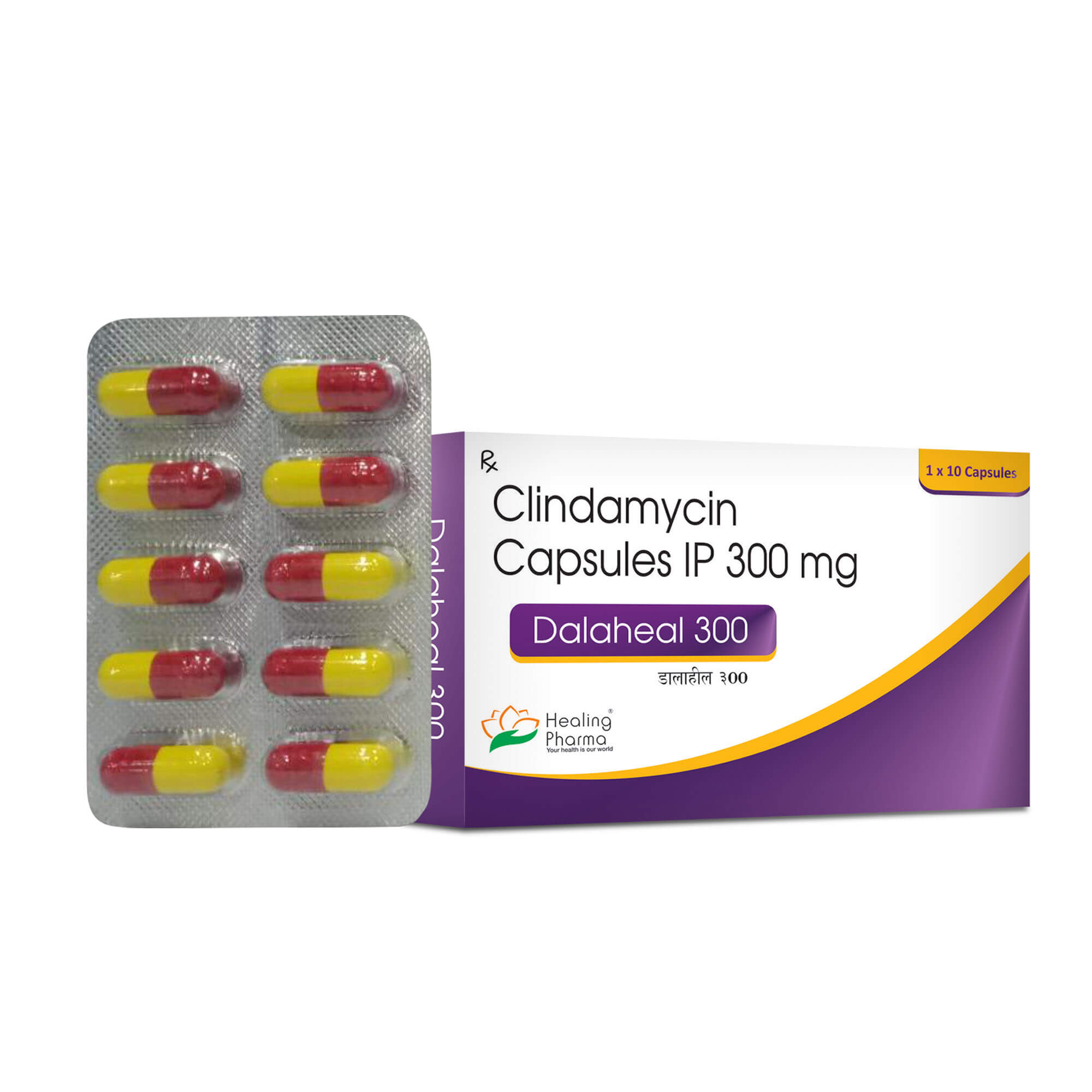
The product shown is Dalaheal 300, labeled as Clindamycin Capsules IP 300 mg, with 10 capsules in one strip.
Clindamycin treats certain serious bacterial infections caused by susceptible organisms, particularly those involving anaerobic bacteria and certain susceptible strains of streptococci, staphylococci, and pneumococci.
What Is Clindamycin 300 Mg?
Clindamycin 300 Mg contains clindamycin hydrochloride equivalent to 300 mg of clindamycin in each capsule.
Clindamycin is part of the lincosamide family of antibacterial medicines. Rather than attacking bacteria in the same way as antibiotics that interfere directly with cell-wall formation, clindamycin primarily works by affecting the bacterial machinery responsible for producing proteins.
The 300 mg strength is particularly useful when comparing different clindamycin formulations because it tells you exactly how much active clindamycin is present in each capsule.
Clindamycin 300 Mg Uses
Clindamycin 300 mg is used to treat certain serious bacterial infections caused by susceptible bacteria. The current U.S. labeling for oral clindamycin includes serious infections caused by susceptible anaerobic bacteria and certain susceptible streptococci, pneumococci, and staphylococci.
Depending on the causative organism and infection site, labeled uses include:
Serious Skin and Soft-Tissue Infections
Clindamycin may be used for certain serious bacterial infections involving the skin and soft tissues when the responsible bacteria are susceptible to clindamycin.
Respiratory Tract Infections
The labeled uses include certain serious respiratory infections caused by susceptible bacteria, including infections involving anaerobic organisms and susceptible streptococci or pneumococci.
Intra-Abdominal Infections
Clindamycin is also indicated for certain serious intra-abdominal infections involving susceptible anaerobic bacteria, including conditions such as peritonitis and intra-abdominal abscesses.
Pelvic and Female Genital Tract Infections
Certain serious infections of the female pelvic and genital tract are included among labeled uses, including endometritis and pelvic cellulitis when susceptible bacteria are involved.
Other Serious Bacterial Infections
Clindamycin can also be used for other infections caused by susceptible bacteria when its antibacterial spectrum is appropriate.
How Does Clindamycin 300 Mg Work?
Clindamycin works by interfering with bacterial protein synthesis.
Bacteria require proteins for numerous essential processes, including growth, reproduction, and maintenance of their cellular functions.
Clindamycin binds to the 50S subunit of bacterial ribosomes and interferes with protein synthesis. By disrupting this process, clindamycin inhibits the growth of susceptible bacteria.
In simplified form:
Clindamycin → binds to bacterial ribosomes → interferes with protein synthesis → inhibits susceptible bacterial growth.
Because its action depends on the susceptibility of the bacteria, clindamycin is not effective against every type of bacterial infection.
This is one reason bacterial susceptibility and the location of the infection are important when selecting an antibiotic.
Why Choose Clindamycin 300 Mg?
The 300 mg strength provides a clearly defined amount of clindamycin in each capsule.
The product shown in the image, Dalaheal 300, is labeled as Clindamycin Capsules IP 300 mg and comes in a 1 × 10 capsule pack.
Key Product Features
- 💊 300 mg clindamycin per capsule
- 🦠 Antibacterial activity against susceptible bacteria
- 📦 Convenient capsule formulation
- 🔬 Lincosamide-class antibiotic
- 📋 Clearly identified active ingredient and strength
- 10 capsules shown per pack
Clindamycin 300 Mg Dosage
The appropriate Clindamycin 300 mg dosage varies according to the infection being treated and individual circumstances.
The official labeling provides different dosing ranges depending on the severity and location of the infection. Therefore, simply taking one 300 mg capsule at a fixed frequency is not an appropriate universal dosing instruction.
The complete course and dosing schedule should follow the instructions provided for the specific patient and infection.
Important Points About Clindamycin Dosage
- Do not change the amount on your own.
- Do not take extra capsules to compensate for a missed dose.
- Do not extend treatment unnecessarily.
- Do not use leftover antibiotics for a new infection.
Using antibiotics incorrectly can contribute to bacterial resistance and may also expose a person to unnecessary adverse effects.
How to Take Clindamycin 300 Mg
Clindamycin capsules are taken orally.
The capsule should be swallowed with an adequate amount of water. Taking the capsule with sufficient fluid helps reduce the risk of irritation of the esophagus.
Important practical points include:
- Swallow the capsule with water.
- Avoid taking more than the instructed amount.
- Try to take doses at consistent intervals when a schedule has been provided.
- Do not share antibiotics with another person.
If a dose is missed, the appropriate response depends on how close it is to the next scheduled dose. Doubling doses is generally not appropriate unless specifically instructed.
Clindamycin 300 Mg Side Effects
Like other antibiotics, clindamycin can cause side effects.
Commonly reported effects can include:
- Diarrhea
- Abdominal discomfort
- Nausea
- Vomiting
- Skin rash
Clindamycin 300 Mg Precautions
Clindamycin should be used carefully because of its potential gastrointestinal effects and the risk of antibiotic-associated colitis.
People with a previous history of colitis or significant gastrointestinal disease should make this known before treatment. The labeling recommends caution in individuals with a history of gastrointestinal disease, particularly colitis.
Clindamycin is also contraindicated in people with a known hypersensitivity to clindamycin or lincomycin.
Severe allergic reactions have also been reported, including anaphylactic reactions and serious skin reactions such as Stevens-Johnson syndrome and toxic epidermal necrolysis.
Clindamycin 300 Mg and Antibiotic Resistance
Antibiotic resistance is an important reason to use clindamycin carefully.
Clindamycin should be used when a bacterial infection is proven or strongly suspected to involve susceptible bacteria. When culture and susceptibility information are available, those results can help guide antibiotic selection.
Using antibiotics when they are not needed—for example, for viral infections—does not provide antibacterial benefit and contributes to unnecessary antibiotic exposure.
Clindamycin 300 Mg Storage
Store Clindamycin 300 Mg capsules according to the product label.
General storage practices include:
- Keep capsules in their original packaging.
- Store in a dry location.
- Protect from excessive heat.
- Keep away from direct sunlight.
- Keep the container properly closed.
- Keep out of reach of children.
Always check the manufacturer’s packaging for specific storage requirements.
Frequently Asked Questions
1. What is Clindamycin 300 Mg?
Clindamycin 300 Mg is an oral capsule containing 300 mg of clindamycin, a lincosamide-class antibacterial medicine.
2. What is Clindamycin 300 Mg used for?
It is used for certain serious bacterial infections caused by susceptible bacteria, including certain respiratory, skin and soft-tissue, intra-abdominal, and pelvic infections.
3. Is Clindamycin 300 Mg an antibiotic?
Yes. Clindamycin is an antibacterial antibiotic belonging to the lincosamide class.
4. Does clindamycin work against viruses?
No. Clindamycin targets susceptible bacteria and is not a treatment for viral infections.
5. How many Clindamycin 300 Mg capsules should I take?
The appropriate amount depends on the infection and individual factors. A fixed 300 mg schedule should not be assumed to apply to every infection.
6. Can Clindamycin 300 Mg cause diarrhea?
Yes. Diarrhea is a known adverse effect, and clindamycin also carries a significant warning for potentially serious C. difficile-associated diarrhea and colitis.
7. Can diarrhea happen after finishing clindamycin?
Yes. C. difficile-associated diarrhea can occur after antibacterial treatment has ended, and the labeling notes that it may occur up to two months after treatment.
8. Who should avoid clindamycin?
People with a known hypersensitivity to clindamycin or lincomycin should not use it. Those with a history of colitis or significant gastrointestinal disease require particular caution.
9. What is Dalaheal 300?
The product shown in your image is Dalaheal 300, labeled as Clindamycin Capsules IP 300 mg, with a 1 × 10 capsule pack.
10. What is the difference between Clindamycin 300 Mg and lower strengths?
The main difference is the amount of active clindamycin per capsule. A 300 mg capsule contains more clindamycin than a 150 mg capsule.
11. Can I use leftover clindamycin for another infection?
No. Different infections can involve different bacteria, and unnecessary antibiotic use can contribute to resistance and adverse effects.


Reviews
There are no reviews yet.